Engineers, Stop Worrying About AI - There Are Many Areas Where Software Is Still Needed
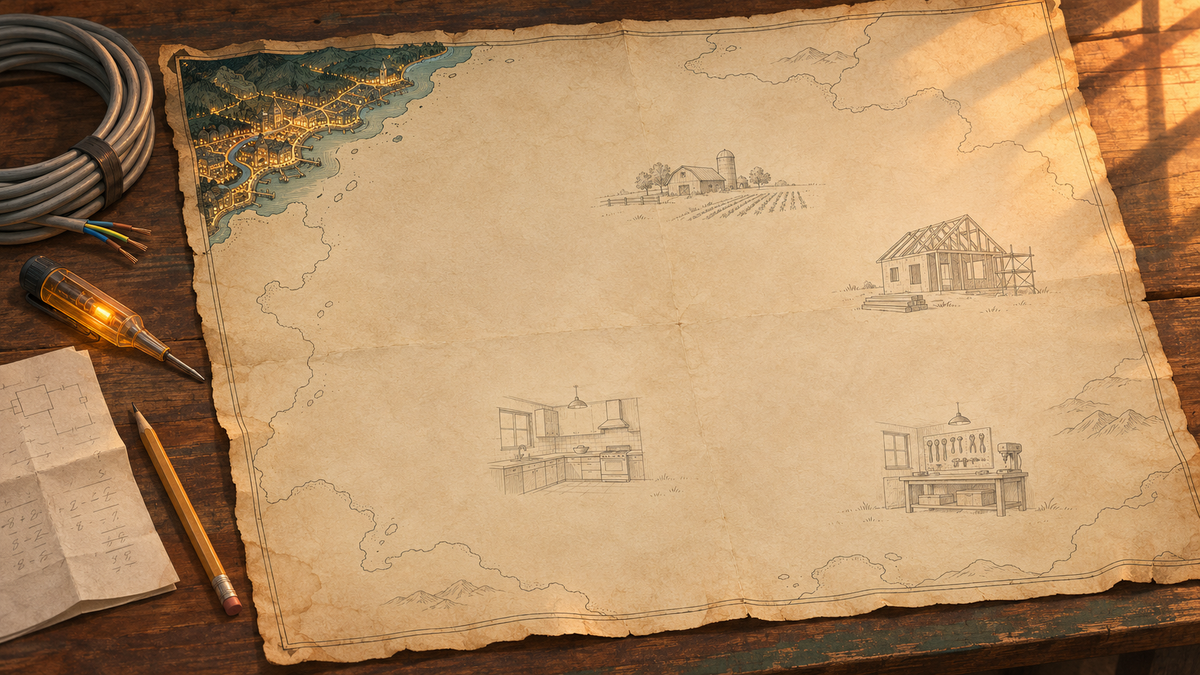
Like many software engineers who love their job and enjoy writing code, I am startled by what AI can now do in this area. For a couple of months I have been asking myself the same question: how long do I have before I become obsolete and software gets written with no human involved at all, not as a coder, not as a reviewer, not as a tester? Reading post after post on the topic, I can see that I am not alone in my worries. And yet I think they are overblown. With this article I want to start a conversation that proves it.
I recently asked an electrician to come to my home and estimate the cost of installing an autonomous power system, fed by both batteries and a generator. He examined everything quite thoroughly: the incoming power line, the box with the circuit breakers, the spot where I would like the batteries to sit, and the wall he would have to drill through to run new cables to the generator outside. Then he wrote something on a sheet of paper, turned a few ideas over in his head and gave me an estimate that was neither specific nor accurate. That part was normal, and we both knew it. What surprised me most was that during the whole visit he never once touched an electronic device, let alone a piece of software that could have helped him with the task.
What was missing from that visit
I kept thinking about it after he left. Nothing he did in my home was exotic from a software point of view. Sizing batteries for a household load is arithmetic. Choosing a cable cross-section for a given current and distance is a lookup table with a safety margin on top. Pricing the materials is a query against a supplier's catalogue, and the price of labour is a number he already carries in his head. A phone with a camera and a decent app could have turned his walk through my home into a parts list and a quote before he reached the front door.
I am not criticising him. He is clearly good at the part of his job that matters, and tools for the rest probably exist somewhere; they have not reached him, which from where he stands is the same as not existing. Meanwhile we, the people who write software for a living, spend our evenings worrying that a machine will take the last ticket from our backlog. Either software has already reached everyone who needs it and I happened to meet the one exception, or we have been staring at a very small corner of the map.
The worry is not imaginary
Let me be fair to the fear first, because the numbers behind it are real. Three Stanford economists, working with payroll records from ADP, found that employment of software developers aged 22 to 25 had fallen by nearly 20% from its late-2022 peak, while older developers in the same occupation held their ground. Indeed's Hiring Lab reported in July that postings for software development jobs in the US were still about 27% below their pre-pandemic level. They have been climbing again since early 2025, but most of that recovery went to senior roles. If you are a junior engineer competing for a generic web development position, the market really has changed, and I will not pretend otherwise.
What strikes me is where all of this is happening: inside the software industry itself, the one part of the economy that was saturated with code long before the models arrived. AI makes the writing of software cheaper. That is bad news for those who sell the writing by the hour in places that already have plenty of it, and rather good news for every place that could never afford any.
What the statisticians know
So how much of human activity has software actually reached? I assumed that somebody had measured this properly, and I went looking. What I found is a handful of serious attempts, each of which measures something close to the question and none of which measures the question itself.
The OECD published a taxonomy in 2018 that ranks 36 sectors by digital intensity, using indicators such as investment in software, purchases of ICT services, the share of ICT specialists and online sales; agriculture, mining, real estate and construction ended up at the bottom.
McKinsey's Industry Digitization Index, built in 2015 from 27 indicators, concluded that the US economy was reaching only about 18% of its digital potential, with agriculture last and construction, hospitality and healthcare not far above it. Nobody has publicly refreshed that index since, which says something about how much attention the question receives.
The freshest numbers come from Eurostat, which counts how many of twelve basic digital technologies a company uses and calls four of them a "basic" level. In 2025, 72% of EU companies got there, and in information and communication almost all of them did. In construction and in transport, roughly four firms in ten used fewer than four; in accommodation and food services, about a third. The survey covers only companies with ten or more employees and leaves agriculture out entirely, so a self-employed electrician is not even in the sample.
The American picture is similar. According to the Minneapolis Fed's reading of Census Bureau survey data, about 20% of US firms were using AI in early 2026: nearly four in ten in information and professional services, and fewer than one in ten in agriculture, transportation, construction, and accommodation and food services. The methods differ and so do the continents, but the sectors at the bottom are the same every time.
The question nobody asks
What bothers me as an engineer is what these indices actually count. They count money spent on IT, or the number of technologies a firm has adopted, or how much workers use computers; the Brookings digital scores do the last of these for 545 occupations and stop in 2016. The newer AI exposure studies, from "GPTs are GPTs" to Anthropic's Economic Index, estimate which tasks a model could perform or is already being asked to perform. All of that is useful, and none of it tells me what share of the real work in a given activity is supported by software that fits it.
A construction firm with a website, email and cloud accounting counts as digitised in the statistics, even if its crews schedule jobs in a messenger group and the foreman keeps the list of defects in a notebook. A spreadsheet used as a workaround scores the same as a purpose-built tool. Firms below ten people mostly do not exist for the surveys, and neither do the hours all of us spend running households and looking after relatives. As far as I could find, no statistical office and no research group publishes a task-by-task measure of software coverage. So let me propose one, with a clear warning that this is a draft from an engineer and not established science.
An index of our own
I would call it the Activity Software Coverage Index (ASCI). Its unit is the task, not the firm and not the industry. For paid work the tasks already exist in public form: the American O*NET database lists roughly twenty of them per occupation. For unpaid work, national time-use surveys provide the activity codes.
Each task gets one of five levels. Level zero means no software at all: paper, memory, phone calls, or purely physical work. Level one means generic tools pressed into service, such as a spreadsheet, a messenger or email. Level two means dedicated software that exists for this task and is really used for it. Level three means the dedicated tool shares its data with the neighbouring tasks, so that a quote becomes an order and then an invoice without anyone retyping it. Level four means the software does most of the task and the human supervises. The levels translate into scores of 0, 0.25, 0.5, 0.75 and 1.
The index for an activity is the average of those scores, weighted by the hours people spend on each task, so it runs from zero to one. For a founder the more interesting number is its complement, the uncovered hours: human time spent on work that software could support and does not. It is a market size expressed in the most honest currency I know.
Scoring one electrician
To show how it works, here is my attempt at an electrician's working week. The time shares are my own guesses, made from the outside, and if you are an electrician I would be glad to be corrected.
| Task | Share of the week | What is used today | Score |
|---|---|---|---|
| Installation and repair on site | 55% | Hands and tools | 0 |
| Travel between jobs | 12% | A maps app | 0.25 |
| Estimating and quoting | 10% | Paper, at best a spreadsheet | 0.25 |
| Scheduling and talking to customers | 8% | Phone and messenger | 0.25 |
| Ordering materials | 5% | Phone, the supplier's website | 0.25 |
| Invoicing and bookkeeping | 6% | An accounting app | 0.5 |
| Compliance paperwork | 4% | Paper forms | 0 |
Multiply each share by its score, add them up, and the index comes to roughly 0.12. I was generous with the quoting row, since my own electrician used nothing but paper. One may fairly object that software cannot pull a cable through a wall, so I removed the physical work and recalculated for the remaining desk-and-phone part of the job, which gives about 0.26. By this rough count, three quarters of the work that software could plausibly support in this trade is still done without it. The exact figure is certainly wrong. I doubt the order of magnitude is.
Why nobody built it yet
If the gap is that large, why is it still there? There are good reasons, and anyone tempted by this article should know them before resigning from anything. First, the buyers are fragmented: there are a great many small firms, each has to be reached separately, and they do not read the websites we read; they trust their supplier, their trade association and their brother-in-law. Second, the margins are thin, and a tradesman will not pay enterprise prices for anything. And finally, the work itself is hostile to software as we usually build it, because it happens in basements and fields, with poor signal, dirty hands and no patience for typing.
Almost every item on that list, however, is a cost. Until recently a tailored product for a narrow trade needed a team, and a market of twenty thousand customers paying a modest monthly fee could not feed a team. It can feed one or two engineers who use AI as their team. Voice and camera interfaces, which were clumsy only a few years ago, now make dirty-hands work reachable. The same technology that frightens the engineer who competes on producing generic code gives an unusual advantage to the engineer who takes the trouble to learn how an electrician actually spends his week.
You are welcome there
I do not know how many people will be writing code inside large software companies in five years; fewer than today seems a reasonable guess. What I do know is that software has barely started on most of the hours people spend working, and that those able to build it are few compared with the work waiting for them. So, dear founders and engineers: there is more uncovered ground out there than all of us could build on in a career, and you are more than welcome to bring your passion and creativity to it.
I promised a conversation, so here is my half of it. Pick one activity you can observe closely, whether a trade, a clinic, a farm or your own household; write down the tasks, guess the hours and score them. Then tell me where my levels or my electrician's numbers are wrong. If enough of us do this, we will end up with the map the economists never drew.